What is Pain?
If you've ever thrown your back out picking up a sock, wondered why an old injury still aches years later, or questioned how an MRI can look terrible while someone feels perfectly fine…you're not alone.
Pain is one of the most misunderstood experiences in healthcare.
For decades, many of us were taught a simple equation:
More damage = More pain.
It sounds logical.
The problem?
That isn't how pain actually works.
Modern pain science has completely changed how we understand pain, and understanding it can often be one of the first steps toward recovering from it.
Pain Is an Experience… Not Just a Signal
Pain is one of the most heavily researched topics in neuroscience, rehabilitation, and medicine.
What’s fascinating is there isn't one universally accepted explanation of what pain is.
The International Association for the Study of Pain (IASP) (which is the gold standard) defines pain as:
"An unpleasant sensory and emotional experience associated with, or resembling that associated with, actual or potential tissue damage."
Notice something important.
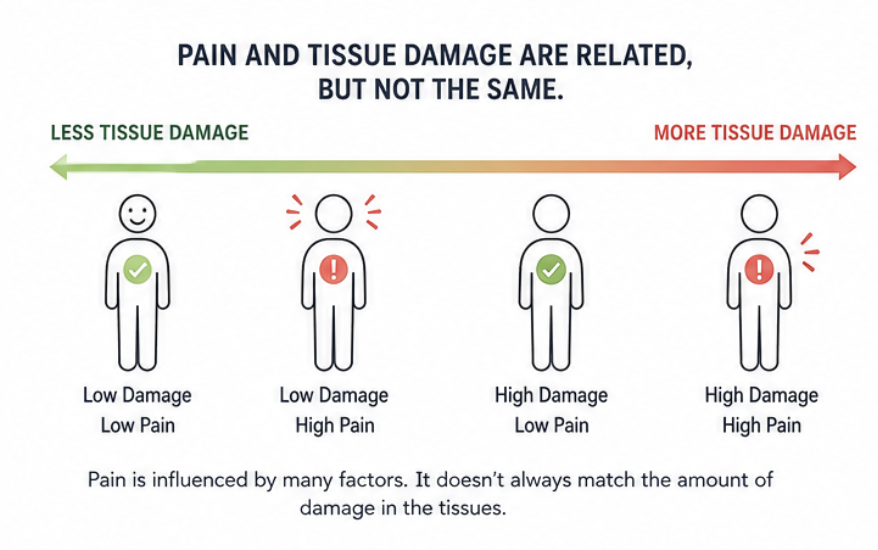
Pain is associated with tissue damage, not a direct measurement of it.
It says pain is an experience associated with damage (or potential damage).
The IASP also released six accompanying notes that are arguably even more important.
Some highlights:
Pain is always a personal experience.
Pain is influenced by biological, psychological, and social factors.
Pain and nociception (defined as the neurological process that encodes information about harmful stimuli) are different.
A person's report of pain should be respected.
People can experience pain without tissue damage.
People can have tissue damage without pain.
These notes summarize DECADES of research.
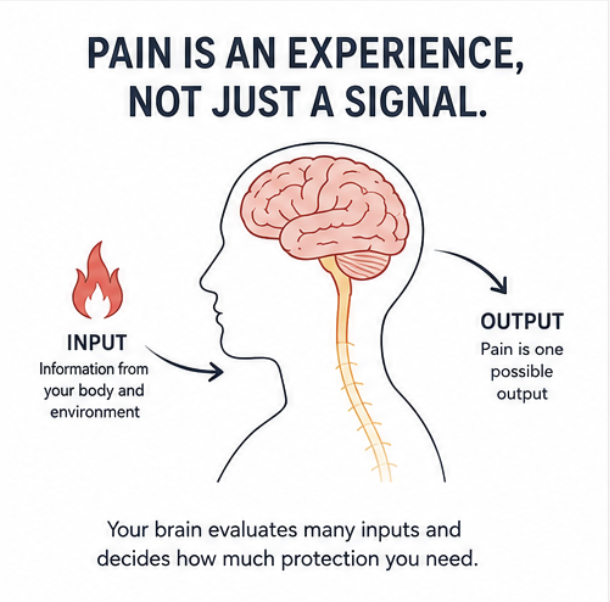
So, in a nutshell, pain can be described as something your brain creates after evaluating information from throughout your body and environment. That evaluation happens incredibly fast and usually outside of your conscious awareness.
Think of pain less like a thermometer measuring tissue damage and more like your body's alarm system.
Your Body Has an Alarm, NOT a Damage Meter
One of my favorite books is a book called Sticks and Stones. It uses analogies to help describe pain for both clinicians and patients. I have taken a few of my favorites and used them throughout this article...
Imagine your home has a smoke detector (which you shouldn’t have to imagine).
Its job is not to detect fire.
Its job is to detect anything it thinks might indicate a fire.
Sometimes there's a real fire.
Sometimes you burn toast.
The alarm isn't lying, per se.
It's simply trying to protect you from potential danger.
Your nervous system works remarkably similarly.
It constantly gathers information from:
Your joints
Muscles
Tendons
Skin
Past experiences
Stress levels
Sleep quality
Emotions
Expectations
Surroundings
Your brain rapidly asks one question:
"How much danger am I in right now?"
If it decides protection is necessary, one possible output is pain.
Pain isn't proof that something is being damaged.
Pain is your body's attempt to protect you.
But Sometimes Pain Does Mean Injury
At this point, you might be thinking:
"So are you saying pain isn't real? Or that injuries don't hurt?"
Not at all.
Sometimes pain is exactly what it should be.
If you roll your ankle, tear a muscle, break a bone, cut your finger, or touch a hot stove, pain is serving its intended purpose. It's alerting you that tissue has been damaged, or is at risk of being damaged, and encouraging you to protect the area while it heals.
That protective response is incredibly important. Without it, we'd continue loading injured tissues and potentially make the injury worse.
The important distinction is this:
Pain is influenced by tissue damage, but it is not a direct measurement of tissue damage.
Think of the volume knob on a speaker.
When you sustain a significant injury, the "danger signal" coming from your tissues is often loud, and pain is an appropriate response. But the brain still controls the volume. Depending on many different factors (including stress, previous experiences, sleep, expectations, and the sensitivity of your nervous system) that same injury may feel very different from one person to another.
Likewise, as tissues heal, the danger signal from the injury usually becomes quieter. Sometimes the brain turns the volume down appropriately and pain gradually fades. Other times, the nervous system remains more protective than necessary, and pain continues even though the tissues have healed well.
Understanding this doesn't minimize the reality of injury (and I think this is very important). Instead, it helps explain why two people with similar injuries can have very different pain experiences, and why someone can continue to hurt even after healing has occurred.
The goal isn't to ignore pain. The goal is to understand what your pain is trying to tell you, so you can respond appropriately rather than assuming that every painful movement means you're causing more damage.
Pain Is Like a Security System
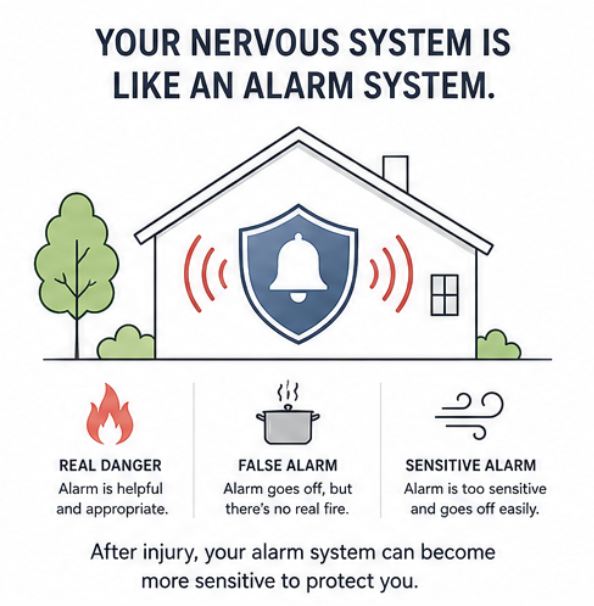
Another helpful analogy from the book Sticks and Stones is to imagine your nervous system as a home security system.
A brand-new security system may only sound when someone actually breaks a window.
But what happens if the sensitivity keeps getting turned up?
Eventually it might activate because:
A branch hits the window
A truck drives by
The wind shakes the house
A cat walks across the porch
The alarm becomes overprotective.
Nothing is actually breaking into the house.
The system has simply become more sensitive.
Our nervous systems can do the same thing.
Following an injury, surgery, or prolonged period of pain, the body's protective system may stay "turned up."
Activities that were once completely safe may now trigger pain, even though no new damage is occurring.
This is known as sensitization, and it is one reason why chronic pain (i.e. pain that lasts for more than three to six months, or well past the normal time it takes for an injury to heal) can persist long after tissues have healed.=
Why Does Pain Sometimes Seem Out of Proportion?
Most tissues in the human body heal remarkably well.
Muscles often recover within weeks.
Many ligaments improve over several months.
Bone heals continuously.
Yet millions of people experience pain for years.
If pain ONLY reflected tissue damage, this wouldn't make sense.
Research consistently shows that:
Many people with no pain have disc bulges, arthritis, rotator cuff tears, and meniscus tears on MRI.
Many people with severe pain have relatively unremarkable imaging.
Imaging findings often reflect normal aging rather than the cause of symptoms.
This doesn't mean injuries aren't real.
It means tissue health is only one piece of a much larger puzzle.
The Brain Is Always Collecting Evidence
One of the central ideas in modern pain science is that your brain acts like an investigator.
Every second, it gathers evidence.
Evidence that you're safe.
Evidence that you're in danger.
Rather than relying on just one piece of information (like an MRI, an injured muscle, or a sore joint) your brain considers countless inputs before deciding how much protection you need. One possible protective response is the sense of pain.
The figure below is one of my favorite visual representations of this concept, and maybe one of the best diagrams I have ever seen in all my years of reading research. It comes from a review discussing the many factors that contribute to low back pain and demonstrates just how complex the pain experience truly is.
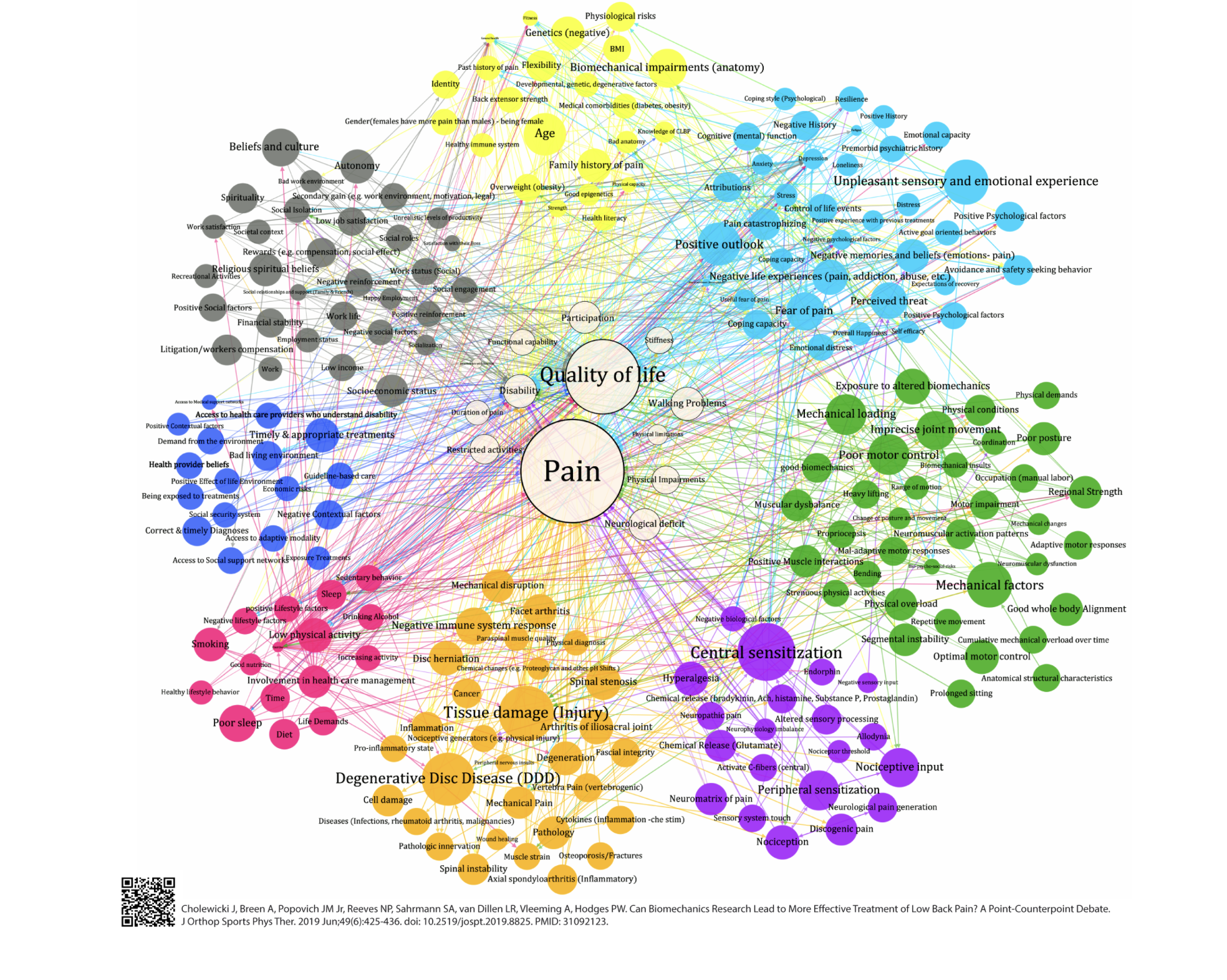
If you stare at this image for too long, you'll get a headache. And that's exactly the point.
Pain sits in the center of the diagram because it is influenced by numerous systems working together. The different colors represent groups of factors that all contribute to the pain experience:
🟠 Orange: Tissue injury and pathology (such as inflammation, arthritis, disc degeneration, or acute injury)
🟢 Green: Mechanical and movement factors (strength, biomechanics, posture, loading, and motor control)
🟣 Purple: Nervous system factors (nociception, central sensitization, and changes in how the nervous system processes pain)
🔵 Blue: Psychological and emotional factors (stress, fear, beliefs, resilience, coping strategies, and previous experiences)
🩷 Pink: Lifestyle factors (sleep, physical activity, smoking, diet, and other health behaviors)
⚫ Gray: Social and environmental factors (family, work, culture, relationships, and social support)
🟡 Yellow: Personal and biological factors (age, genetics, medical history, sex, and overall health)
🔷 Dark Blue: Healthcare factors (diagnosis, communication with healthcare providers, access to care, and previous treatment experiences)
Perhaps the most important feature of this figure isn't the colors... it's the thousands of lines connecting them together.
Every system influences every other system.
Poor sleep can increase stress. Stress can heighten pain sensitivity. Pain can reduce physical activity. Reduced activity can lead to weakness and decreased confidence. Fear of movement can change how we move. Positive experiences with exercise can improve confidence and help calm an overprotective nervous system... and on and on.
Rather than asking, "What's causing my pain?"... a better question is often:
"What factors might be contributing to my pain today?"
Some of the common factors that can increase your nervous system's perception of danger include:
Poor sleep
High stress
Anxiety
Previous painful experiences
Fear of movement
Lack of physical activity
Confusing or threatening medical explanations
Conversely, factors that provide evidence that your body is safe and capable may help reduce pain over time:
Understanding your condition
Gradual exposure to movement
Building strength
Positive movement experiences
Good sleep
Regular exercise
Confidence in your body's ability to adapt
Now let's get one thing straight, this doesn't mean pain is "all in your head."
It means your brain and nervous system are constantly integrating information from your body, your environment, your experiences, and your overall health to determine how much protection you need.
Understanding that concept is empowering. It means there are many different ways to improve pain, not just by treating injured tissues, but by improving strength, movement, sleep, confidence, stress management, and overall health.
Hurt Does Not Always Equal Harm
This may be one of the hardest concepts to accept.
Sometimes movement hurts.
That doesn't automatically mean movement is causing damage.
Think about getting back into exercise after several months off.
Your muscles become sore.
They hurt.
But soreness is a normal adaptation, not an injury.
The same principle often applies during rehabilitation.
As tissues recover and the nervous system becomes less protective, it's common to experience temporary discomfort while gradually rebuilding strength and confidence.
Learning to distinguish between acceptable soreness and true injury is one of the most valuable skills patients can develop.
Movement Is Often Part of the Treatment
Years ago, complete rest was recommended for many painful conditions.
Today, the evidence tells a different story.
For many musculoskeletal conditions, including back pain, neck pain, osteoarthritis, tendinopathy, and many post-operative recoveries, appropriately dosed movement produces better long-term outcomes than prolonged rest.
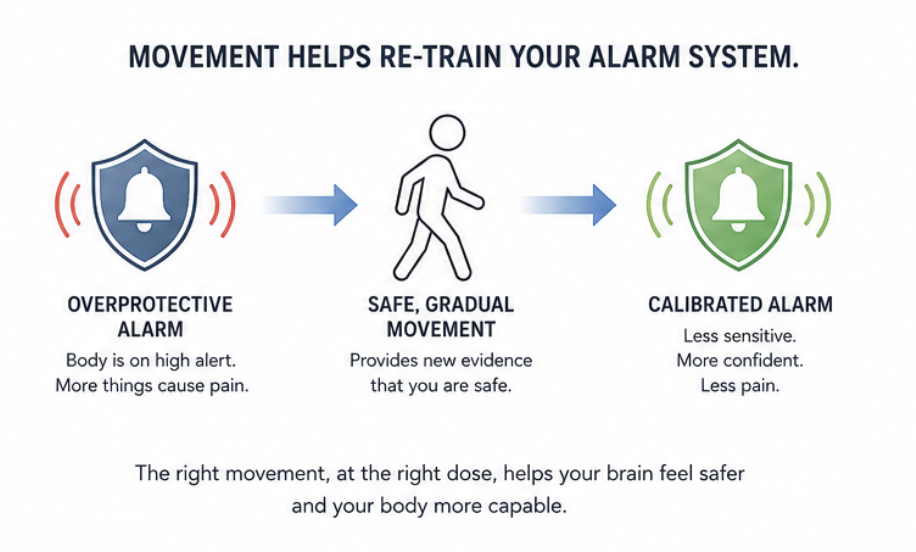
Movement provides your nervous system with new evidence.
It teaches your brain: "I can do this safely."
Over time, those positive experiences help recalibrate an overprotective alarm system.
The goal isn't simply to become stronger.
The goal is to become more confident in what your body can do.
So… What Is Pain?
Despite all of these words, I wish I could unequivocally, 100%, without certainty, tell you EXACTLY what pain is. Unfortunately, despite all the research we have, no one really knows 100%.
But what I can tell you (guided by research), is:
Pain is not weakness.
Pain is not simply tissue damage.
Pain is not something to fear.
Pain is your body's incredibly sophisticated protective system trying to keep you safe.
Sometimes that protection is perfectly accurate.
Sometimes it's overly cautious.
The key isn't to ignore pain. It's to understand what it may be telling you and respond appropriately.
Understanding the difference changes everything.
At Resilient Spine & Performance, our goal isn't simply to reduce pain.
It's to understand why your nervous system is producing pain, identify the factors contributing to it, improve tissue capacity through progressive exercise, and help you regain confidence in movement.
Because when you understand pain, you stop seeing your body as fragile.
You begin to recognize it for what it truly is:
An adaptable, resilient system that is constantly learning, changing, and capable of becoming stronger.
References
Brinjikji W, Luetmer PH, Comstock B, et al. (2015).Systematic Literature Review of Imaging Features of Spinal Degeneration in Asymptomatic Populations.American Journal of Neuroradiology, 36(4), 811–816.
Butler DS, Moseley GL. (2013).Explain Pain(2nd ed.). NOI Group Publications.
Cholewicki J, Breen A, Popovich JM Jr, Reeves NP, Sahrmann SA, van Dillen LR, Vleeming A, Hodges PW. (2019).Can Biomechanics Research Lead to More Effective Treatment of Low Back Pain? A Point-Counterpoint Debate.Journal of Orthopaedic & Sports Physical Therapy, 49(6), 425–436.
Hartvigsen J, Hancock MJ, Kongsted A, et al. (2018).What Low Back Pain Is and Why We Need to Pay Attention.The Lancet, 391(10137), 2356–2367.
Heafner J, Hall J.Sticks and Stones: A Patient's Guide to Pain, Injury, and Recovery.(Update the publication year and publisher to match your copy.)
International Association for the Study of Pain (IASP). (2020).IASP Announces Revised Definition of Pain.
Louw A, Zimney K, Puentedura EJ, Diener I. (2016).The Efficacy of Pain Neuroscience Education on Musculoskeletal Pain: A Systematic Review of the Literature.Physiotherapy Theory and Practice, 32(5), 332–355.
Melzack R. (1999).From the Gate to the Neuromatrix.Pain, Supplement 6, S121–S126.
Melzack R, Wall PD. (1965).Pain Mechanisms: A New Theory.Science, 150(3699), 971–979.
Moseley GL. (2003).A Pain Neuromatrix Approach to Patients with Chronic Pain.Manual Therapy, 8(3), 130–140.
Raja SN, Carr DB, Cohen M, et al. (2020).The Revised International Association for the Study of Pain Definition of Pain: Concepts, Challenges, and Compromises.Pain, 161(9), 1976–1982.
Medical Disclaimer
This article is intended for educational purposes only and should not be interpreted as medical advice or a substitute for an evaluation by a qualified healthcare professional. Pain is a complex experience influenced by many factors. While pain is not always a sign of tissue damage, itcanbe an important warning sign of serious injury or illness. If you experience severe, unexplained, worsening, or persistent pain (or symptoms such as significant weakness, numbness, loss of bowel or bladder control, fever, unexplained weight loss, or pain following major trauma) seek prompt medical evaluation.