Why Do We Train?
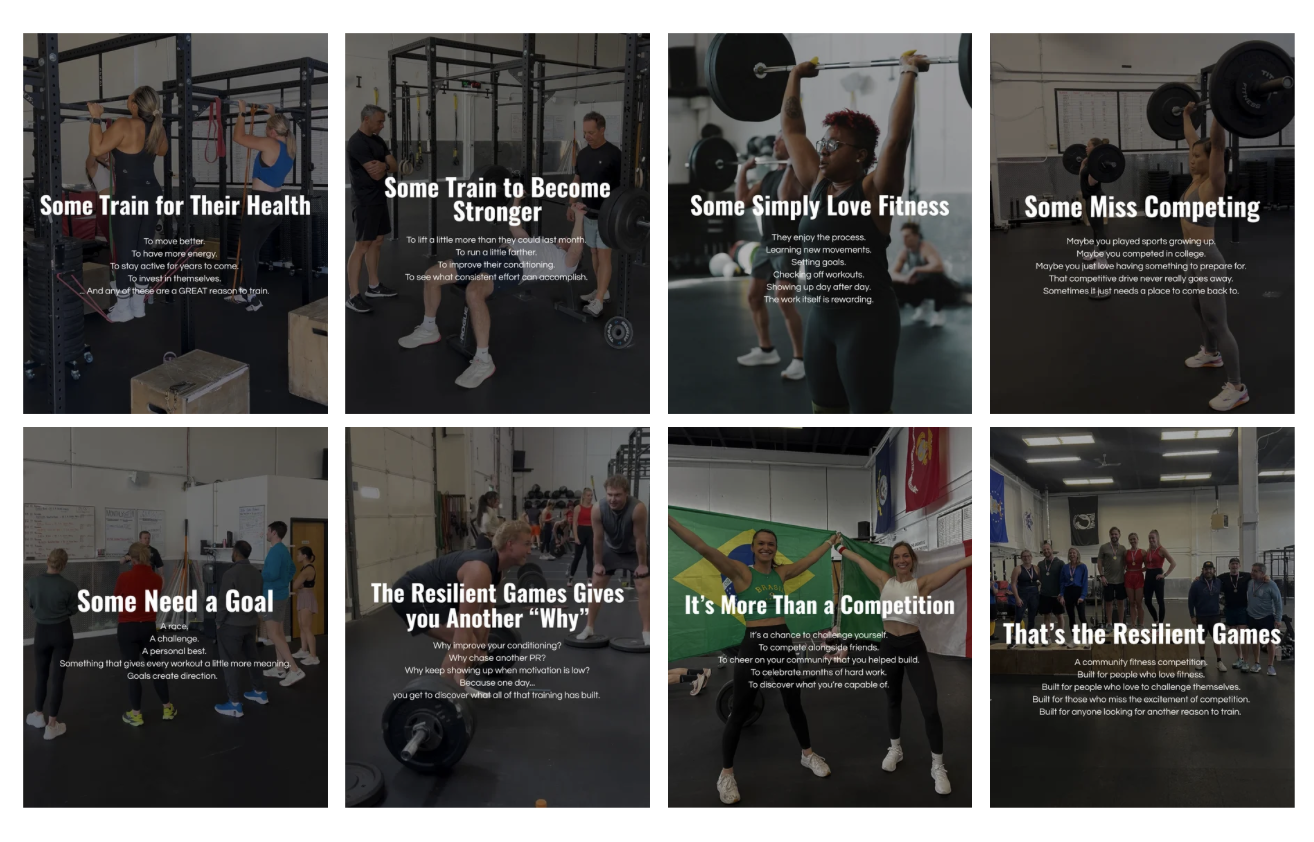
We recently posted several images in a post to social media asking a simple question:
"Why do we train?"
The purpose of the post wasn't to necessarily promote the Resilient Games, although that certainly inspired the conversation. Instead, it was to acknowledge something I've noticed over the years as both a Coach and a gym owner...
There is no single reason why people walk through our doors.
One of the most rewarding parts of coaching is getting to know the people behind the workouts.
On the surface, two people may look like they're doing the exact same class. They're both squatting, rowing, lifting, and sweating through the same conditioning workout.
But the reason they showed up that day might be completely different.
One person is trying to lower their blood pressure.
Another wants to lose twenty pounds.
Someone likes to really push their body.
Someone else is training for a 5k.
Another is chasing a heavier deadlift.
One member simply enjoys the structure and routine.
Another misses the camaraderie and competition that sports once provided.
They're all doing the same workout.
They're all training for something different.
And I think that's pretty incredible.
There Isn't A "Right" Reason To Train
Sometimes people feel like their goals aren't significant enough.
They'll say things like,"I'm not trying to compete or anything..."almost as if they need to apologize for it.
The truth is, you don't need to justify why you're here.
If your goal is to stay healthy enough to play with your kids, that's meaningful.
If your goal is to improve your mile time, that's meaningful.
If your goal is to get stronger, that's meaningful.
If you simply enjoy working out with friends after work, that's meaningful too.
Fitness doesn't have to look the same for everyone.
In fact, I don't think it should, and we embrace that.
Where The 'Resilient Games' Fits In
Some people come to the gym because they like to have something to chase... something to train for.
This is exactly why we decided to create the Resilient Games.
Yes, it's a fitness competition.
Yes, there will be leaderboards, divisions, and a championship event.
But that's only part of the story.
For some people, the Resilient Games becomes another "why."
It gives purpose to the extra conditioning session.
It gives context to chasing another personal record.
It provides a date on the calendar that makes months of consistent training feel even more rewarding.
For others, it won't become their "why" at all, and that's perfectly okay.
Maybe they'll volunteer.
Maybe they'll come cheer on friends.
Maybe they'll simply enjoy being part of an exciting day for our community.
The goal has never been for every member to compete in a fitness event.
The goal has always been to create another opportunity for people who enjoy having something to train toward.
Why Your "Why" Matters To Us
One of the questions I challenge myself to answer (and one I encourage every one of our coaches to ask) is:
"Why does this person train? Why are they here?"
Not because we need to know every detail of someone's life.
Not because there's a right or wrong answer.
But because understanding someone's motivation helps us coach them in the best way possible.
If someone walks into the gym because they want to discover what their body is capable of, we know they probably appreciate being challenged. They may want us to push them, encourage them to try the heavier weight, or remind them that they're capable of more than they think.
On the other hand, someone else may be here simply because they want to stay active, feel healthier, and enjoy moving their body. They may not be interested in chasing personal records or testing their limits every day. They are here to feel good.
For this person, our role isn't to turn them into someone they're not. Our role is to help them leave feeling successful, confident, and excited to come back.
Neither approach is better.
They're simply different.
That's why knowing each person's "why" matters.
It shapes how we coach.
It shapes the conversations we have.
It shapes the type feedback we give.
Ultimately, it helps us meet people where they are, instead of expecting everyone to want the same thing.
My hope is that if you've been a part of Resilient for any length of time, you've experienced that firsthand. Now it may not happen the first day (we need a little time to get to know you), but we hope you've felt seen as an individual, not just another person in class, and that our coaches have helped you pursue your goals, whatever they may be.
What We Hope To Build
If there's one thing I hope people recognize about Resilient, it's this:
We aren't trying to build a gym full of people with the same goals.
We're trying to build a gym where people with different goals can thrive together.
Where the person recovering from an injury encourages the former college athlete.
Where someone preparing for their first 5K celebrates the member who just hit a 300-pound squat.
Where the person training for longevity feels just as supported as the person training for competition.
Because what ultimately connects us isn'twhywe train...
It's the fact that we all choose to show up.
We all choose to invest in ourselves.
We all choose to encourage the people around us, even when their goals look different from our own.
That's the culture we want to continue building.
The Resilient Games is simply one expression of that culture, not the sole definition of it.
So... Why Do You Train?
There isn't one perfect answer.
Your reason today may not be the same as it was five years ago.
It may not even be the same a year from now.
Goals evolve. Life changes. Priorities shift.
And that's okay.
Whether you're here for your health, your family, your confidence, your performance, your friends, the competition, or simply because it's the best hour of your day, we're grateful you're here.
Because while everyone's "why" is different, our mission remains the same:
To create an environment where people feel motivated to keep showing up, challenged to become better, and encouraged by a community that celebrates every reason for training.