Your Workout Shouldn't Always Match the Whiteboard (And Why That's a Good Thing)
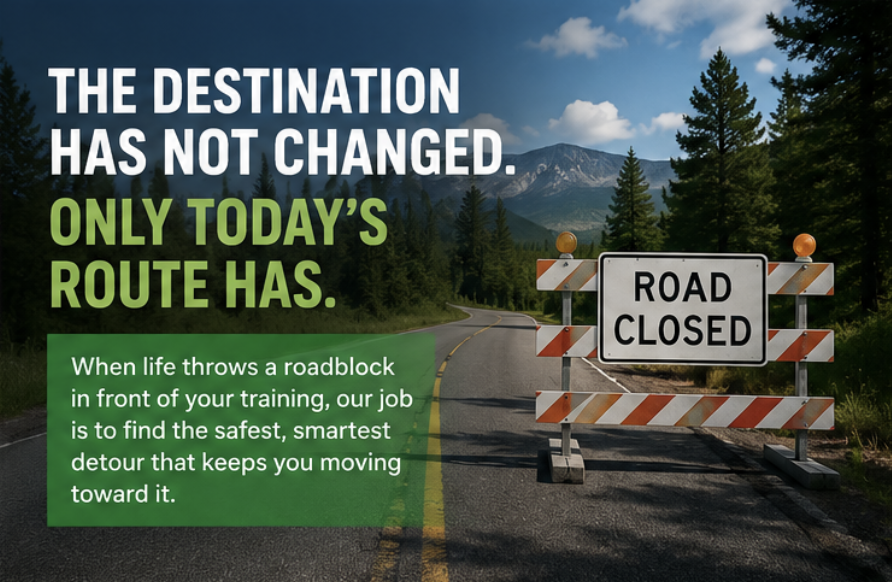
Imagine you're on a family roadtrip...
Driving to a destination you've had planned for months. Your wife has mapped out the exact route, knows exactly where you're going, and knows exactly how long it should take. Halfway there, you come across a road that's unexpectedly closed.
Do you turn around and drive home?
Of course not.
You take a necessary (probably scenic, let's be honest) detour.
The destination hasn't changed... only today's route has.
Training works the exact same way.
In this instance, I am the wife. I build our strength and conditioning cycles weeks, and often months, in advance. Every exercise, progression, and training block has a purpose.
The destination is planned.
But here's the reality:
Life doesn't always follow the program.
And when life throws a roadblock in front of your training, our job isn't to abandon the destination. It's to find the safest, smartest detour that keeps you moving toward it.
Life Doesn't Follow the Program
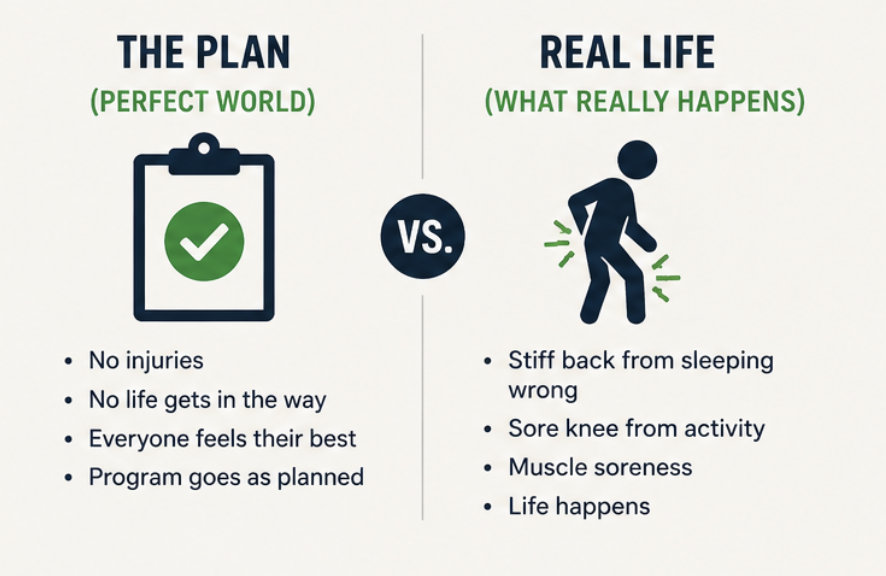
Have you ever woken up after sleeping in an awkward position and your low back feels stiff?
Or spent an entire day walking around Six Flags with your kids only to wake up the next morning with an aching knee?
Maybe yesterday's workout left your shoulders unusually sore, or you spent the weekend helping a friend move and your body simply feels beat up.
Your first thought might be:
"There's no way I can work out today."
Or...
"I want to workout, but there's no way I can do what's on the board today."
To that I say...
That's life.
And life is going to happen.
Vacations happen.
Yard work happens.
Poor nights of sleep happen.
Even great workouts can leave you feeling sore for a day or two.
None of those things mean you need to stop training altogether.
Do NOT be afraid of what is written...
Programming Is Written for the "Perfect World"
When we write strength and conditioning programs, we write them assuming the ideal scenario.
No one gets sick.
No one tweaks their back.
Nobody spends eight hours chasing kids around an amusement park.
Nobody takes a cross-country flight.
In other words, the program is written for a world where nothing unexpected ever happens.
Unfortunately, that's not the world any of us live in.
And that's why coaching exists.
The Goal Isn't to Skip Training... It's to Keep Training
When aches and pains inevitably pop up, my answer USUALLY isn't to stay home (unless it is a serious injury of course).
The answer is to continue training, but sometimes in a different way.
That doesn't mean forcing yourself through painful movements.
It means making intelligent adjustments.
For example, if your low back does feel stiff that morning, maybe instead of performing three heavy sets of three Romanian Deadlifts at an RPE 9, we perform three lighter sets of six while focusing on quality movement, pain-free.
If your knee is sore after walking around Six Flags all day, maybe today's reverse lunges become single-leg Romanian deadlifts instead. We decrease the amount of knee flexion under load while still challenging your balance, coordination, and hip strength.
If your hip is bothering you that morning, maybe heavy squats aren't happening for you that day. We can move to a Leg Press or even a seated leg extension instead to still get a similar movement that day.
You're still training.
You're still getting progressing.
You're still moving toward your goals.
We've simply adjusted today's path to keep you moving forward.
Our job is to not only know as many modifications as possible, but to know when to deliver them and to whom.
Group Programming. Individual Coaching.
One of the realities of group fitness is that everyone walks into class with a different body on a different day.
Some people slept eight hours.
Others slept four.
Some spent the weekend hiking.
Others sat on an airplane for six hours.
Some are completely recovered from yesterday's workout.
Others are still sore.
Some are returning from a week long lake house vacation.
Others have been to the gym 12 days straight.
It would be impossible, and honestly unrealistic, to expect every person to perform exactly the same workout exactly the same way every single day.
There is just too much variance in group classes.
The whiteboard provides the plan.
Our coaches provide the individualization.
That's one of the biggest advantages of having experienced coaches (and Doctors) who understand both strength training and musculoskeletal pain, and especially how they work together.
There should be some wiggle room. There should be room for individualization and modifications.
Movement Is Usually Better Than Rest
One thing I can almost guarantee is this:
On the days when you feel like garbage...
On the days when something aches...
On the days when you question whether you should even come to class...
Movement usually helps.
Not reckless movement.
Not ignoring pain.
But appropriate movement.
Just because something hurts doesn't automatically mean you should avoid it completely.
And just because the whiteboard says to do one exercise at a certain level of intensity, doesn't mean that exact exercise has to be performed that day
Sometimes the smartest decision is simply finding a different way to train. An alternative.
A slightly lighter weight.
A reduced range of motion.
A different variation.
A different loading strategy.
These small adjustments often allow you to keep your momentum rather than losing it altogether.
Consistency Beats Perfection
As I've mentioned before, every member who walks through our doors has a reason for training.
Whatever your reason is, one thing remains true:
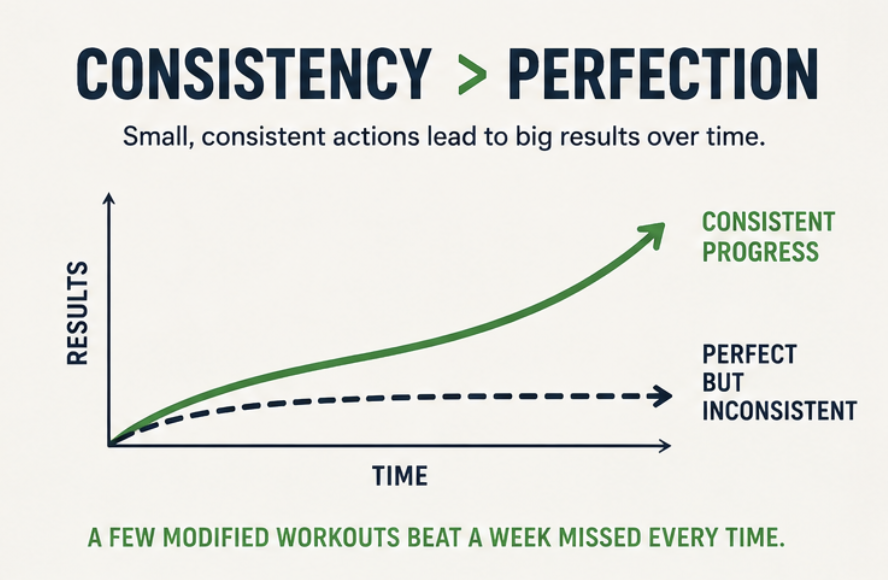
The more consistently you train, the more likely you are to reach your goals.
A few workouts performed at a slightly lower intensity are infinitely more valuable than missing an entire week because you thought everything had to be perfect before returning.
Consistency compounds.
Perfection doesn't.
Modifications Are a Tool... Not the Destination
Now, let's be clear here.
We don't want every workout to require modifications forever.
The original programming exists for a reason.
We deadlift because building strong hips, legs, and low backs makes us more resilient.
We perform full-range reverse lunges because healthy knees benefit from strength through a full range of motion.
We press overhead because maintaining shoulder strength and mobility is critical for long-term function.
The movement standards we coach aren't arbitrary.
They are there to build strength, improve movement capacity, and help keep you active for decades.
Modifications are simply a temporary bridge.
Our goal is always to help you return to your normal baseline whenever possible.
That's how we continue progressing without unnecessary setbacks.
When an Ache Becomes Something More
Now, if you have an injury that continues to linger, or you just can't seem to come back from that stiff back, sore shoulder, or irritated knee, that's where we, the Doctors, step in.
We are not your typical chiropractors. Our goal is not to pull you out of training and have you return to the clinic over and over again. Our goal is to help you understand what is going on, identify what may be limiting your progress, and create a clear path back to full activity, often times in conjunction with your regular training.
Sometimes, added one-on-one time with one of us is exactly what you need. That may include a more detailed examination of the problem area, specific rehabilitation exercises, temporary training adjustments, and a personalized plan designed to help you rebuild your strength and confidence.
The goal is always the same: address the problem, keep you moving whenever possible, and help you return to the movements and activities that matter most to you.
The Resilient Difference
At Resilient, we don't pretend injuries and aches can be completely eliminated. That is impossible and naive.
When people train hard, live active lives, and challenge themselves consistently, things are going to pop up from time to time. Various things will hurt.
That's normal.
What matters isn't avoiding every ache or pain.
What matters is how you respond when they happen.
Managing those situations is what we do every day.
We combine structured, progressive programming with individualized coaching so that life's inevitable bumps don't derail your long-term progress.
Because at the end of the day, resilience isn't about never facing obstacles.
It's about continuing to move forward, even when the path looks a little different than what was written on the whiteboard.
So if you take anything from this article, let it be this...
If something is nagging or hurting a bit and you still want to go to the gym, don’t be afraid of the whiteboard. Modifying your workout isn’t just okay... it’s smart, it’s healthy, and it might even help you feel better when you leave.