Why Your MRI Doesn't Always Explain Your Low Back Pain
"My MRI says I have degenerative discs."
“My MRI says I have bulging discs.”
It's two of the most common statements we hear from new patients or gym members.
Often, it's to explain their history of back pain, or a reason as to why they have not been as active as they’d like to be.
It's a reasonable explanation.
After all, if an MRI shows something abnormal, it seems logical that it must be the source of the pain.
But what if some of the "abnormalities" listed on your MRI are actually incredibly common… even in people who have no back pain at all?
That question was the focus of one of the most influential studies in modern spine research.
A Landmark Study Changed How We View MRI Findings
In 2015, Brinjikji and colleagues published a landmark systematic review in the American Journal of Neuroradiology.
Rather than studying people with back pain, the researchers asked a different question:
What does the average MRI look like in healthy people with no back pain?
To answer it, they analyzed imaging from more than 3,000 asymptomatic (i.e. no symptoms at all) individuals across 33 separate studies.
These were not patients seeking treatment.
These were people who reported no low back pain whatsoever.
The findings were shocking.
The Anatomy
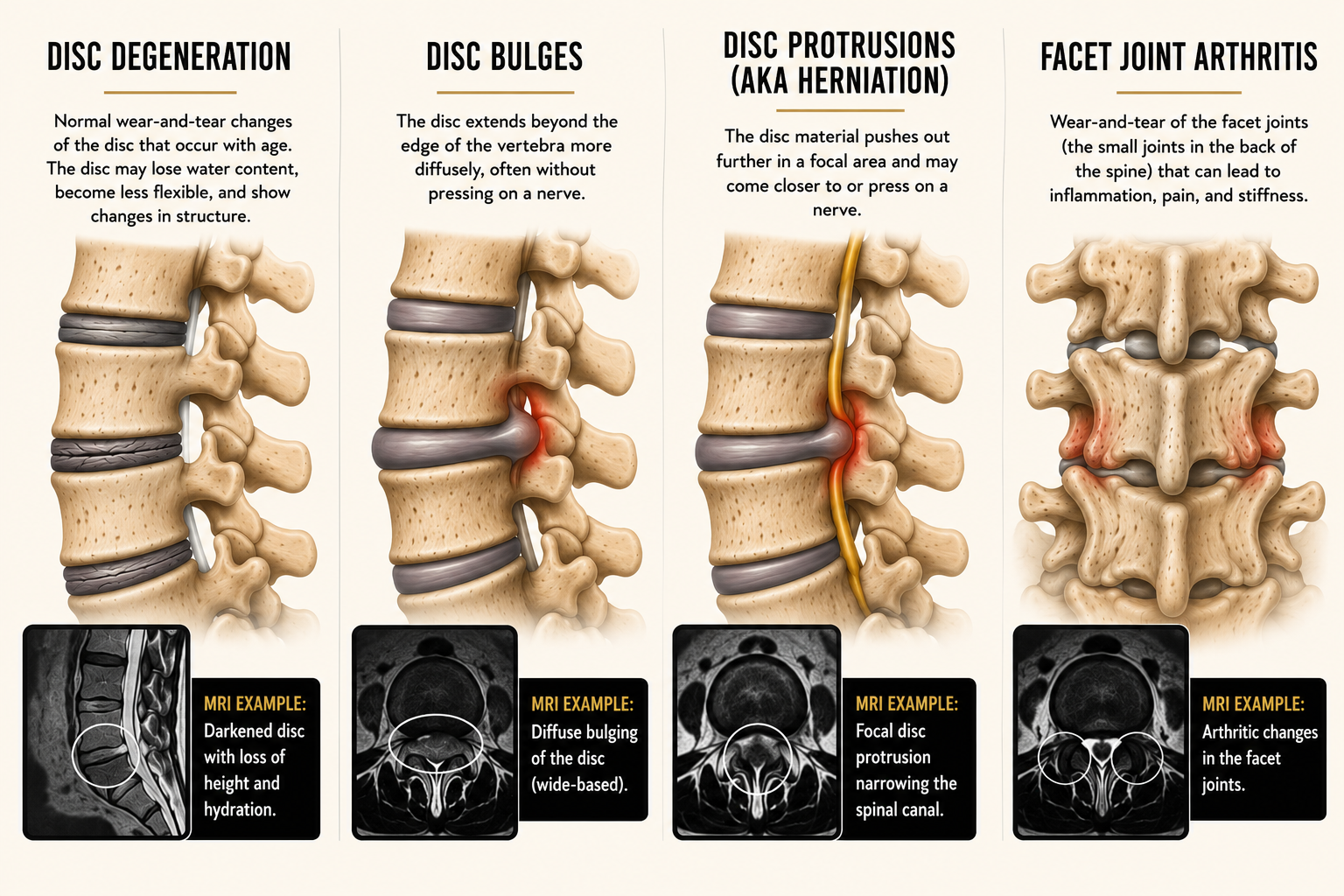
First, let’s look at what they looked for. For the sake of this article, I’ve included the (4) most common (they included others in the study):
Disc Degeneration
Disc Bulges
Disc Protrusions (also known as herniations that are still attached)
Facet Arthritis/Degeneration
Below is an image with descriptions of each:
The Findings
Now… here were the results:
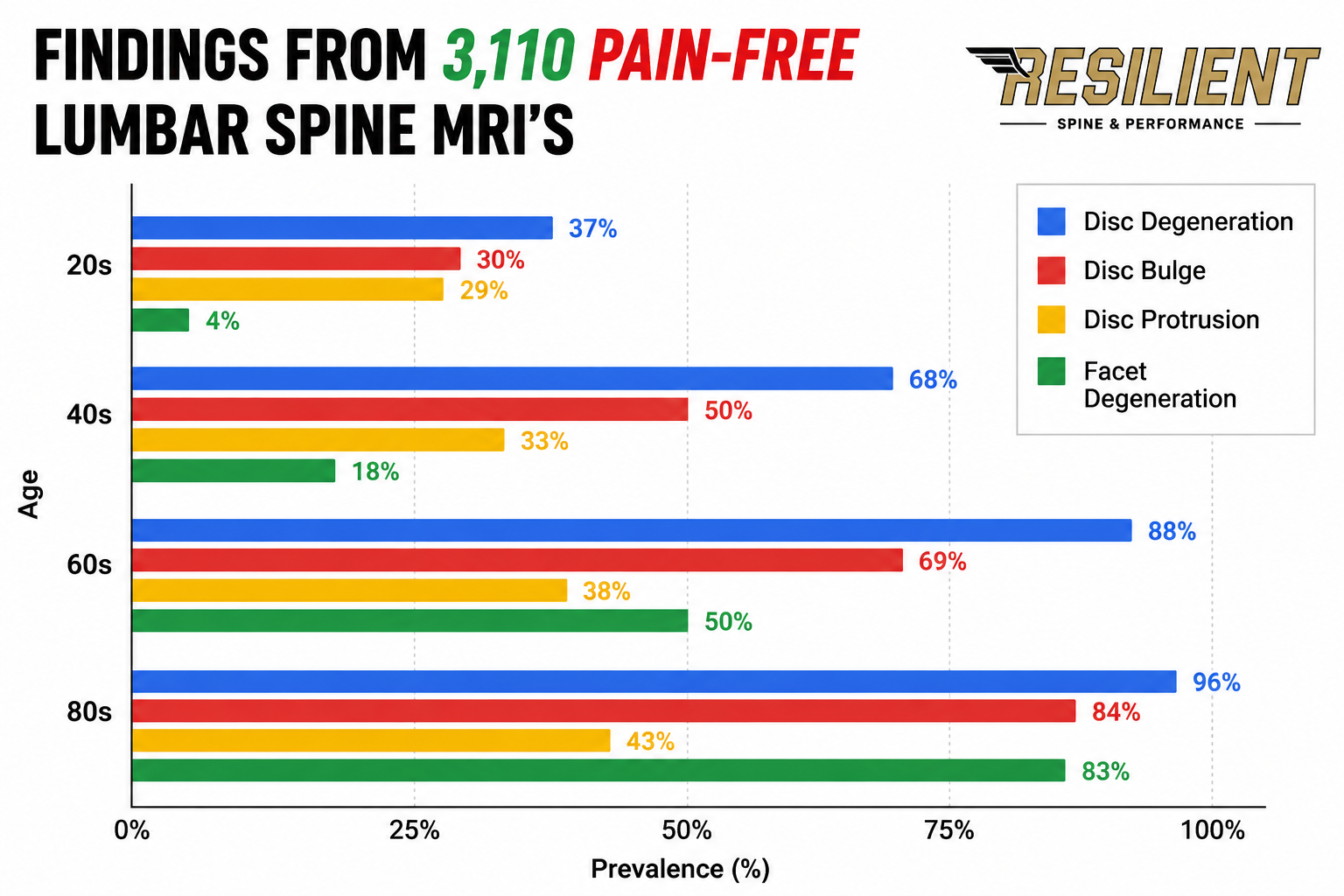
Take a moment to look at those numbers...
Remember… these are PAIN FREE, ASYMPTOMATIC people.
By age 20, more than 1 in 3 healthy adults already had disc degeneration.
By age 40, it was more than 2 out of every 3.
By age 60, nearly 9 out of 10 people had it.
And by age 80, disc degeneration was almost 100%.
Disc bulges were present in about 30% of healthy 20-year-olds.
By age 80, they were seen in more than 80% of people without pain.
Facet joint arthritis followed a similar pattern, becoming increasingly common with age despite the absence of symptoms.
So what does this mean? How does this affect us?
I will answer those questions, but for starters, it shows that many of the findings that sound concerning on an MRI report are actually common features of normal aging.
"Degeneration" Doesn't Mean Your Spine Is Falling Apart
The word degeneration sounds alarming.
It makes many people picture a spine that is worn out, damaged, or slowly breaking down. Frail.
But that's not what the research suggests (I just showed you an example of that above).
A better way to think about it is like gray hair.
As we get older, our hair changes.
We get wrinkles.
Our eyesight worsens.
It happens to everyone. These are normal age-related adaptations, not necessarily signs that something is wrong.
Our spinal structures change over time too.
They gradually lose water (they are made up of 70-90% water), become less flexible, and begin to look different on MRI.
Those changes are often simply part of being human.
Your MRI Is Like Looking at the Outside of a Book
Imagine picking up an old, well-loved book.
The cover is faded.
The corners are bent.
The pages are slightly yellow.
Would you assume it's a bad book?
You shouldn’t.
The appearance tells you the book has been used, not whether the story inside is good or bad.
MRI findings can be similar.
They describe what your spine looks like right that very second… at that moment.
It’s a picture.
They don't necessarily tell us how your spine functions, or what it even looked like 10 years earlier.
And they most definitely don't tell us whether a particular structure is responsible for your pain.
So Why Do Some People Hurt?
This is where MRI has its limitations.
Pain is far more complex than a picture.
An MRI shows us what your spine looks like, but it cannot tell us how sensitive your nervous system is, how strong your muscles are, how much physical capacity your body has, or how confidently you move.
It also can't account for factors like sleep, stress, previous injuries, or your overall health…all of which can influence the experience of pain.
📖 If you'd like to dive deeper into how pain actually works, be sure to read our previous blog, "What Is Pain?", where we explore why pain is much more than simply "damage equals pain."
Two people can have nearly identical MRI findings.
One may deadlift 300 pounds.
The other may struggle to get out of bed.
The MRI alone cannot explain that difference.
More often than not, the difference lies in everything the MRI can't measure
physical capacity
tissue tolerance
movement confidence
nervous system sensitivity
and countless other factors that influence how our bodies respond to the demands we place on them.
But MRI’s Still Do Matter
None of this means MRIs are useless.
Far from it.
MRI is an incredible diagnostic tool.
It helps identify conditions that require immediate attention, such as:
Infections
Tumors
Significant nerve compression
Cauda equina syndrome
Certain inflammatory conditions
Certain Fractures
And many more
In these situations, imaging can be life-changing, or even life-saving.
Throughout my career, I've seen MRIs completely change the course of someone's care by identifying serious pathology that required immediate attention.
Those situations are real, and imaging can be invaluable.
But I've also seen far more people become fixated on MRI findings that were unlikely to be the primary cause of their pain.
They began avoiding activities, fearing movement, and believing their backs were fragile, when in reality their spine and surrounding muscles were often simply deconditioned and lacked the physical capacity to perform the demands they were placing on them.
The problem is not the MRI.
The problem is assuming that every single abnormal finding on an MRI is automatically the source of pain.
It isn't.
It’s more nuanced than that.
We Treat People… Not Pictures
One of the most important jobs of a healthcare provider is determining whether an MRI finding is:
Clinically meaningful,
Simply an age-related change,
Or unrelated to your current symptoms.
That's what we do. That’s why a thorough history and physical examination are so important.
Your MRI is just one piece of the puzzle.
It should always be interpreted alongside:
Your symptoms
Your movement
Your strength
Your goals
Your medical history
Your physical examination
Not by itself.
The Bottom Line
The landmark 2015 review by Brinjikji and colleagues should change the way clinicians, patients, and just active people think about spinal imaging.
It demonstrated that many MRI findings are remarkably common in people who have no back pain at all.
That doesn't mean MRI findings are meaningless. It means they require context.
An MRI can tell us what your spine looks like.
It cannot, by itself, tell us why you hurt.
If you've been told you have "degenerative discs" or “bulging discs” remember this:
Degeneration and bulging discs are often a normal part of aging, not a diagnosis, and not a prediction of your future, and certainly not proof that your spine is damaged beyond repair.
In many cases, the solution is not to protect the spine… it is to progressively rebuild its strength, resilience, and capacity.
Our bodies are incredibly adaptable.
Muscles become stronger. Tendons become more resilient. Bones respond to loading. Even our nervous system becomes less sensitive as confidence and movement return.
The goal should not be to avoid using your back because an MRI found "wear and tear."
The goal is to gradually improve your body's ability to tolerate the demands of everyday life, whether that's picking up your children, carrying groceries, working in the yard, training in the gym, or competing in your favorite sport.
Now that doesn't happen overnight, and it certainly doesn't happen by simply staring at an MRI report.
If you do have a history of low back pain, it happens through thoughtful, progressive rehabilitation and exercise that challenges your body just enough to encourage it to adapt.
Over time, what once felt impossible often becomes routine, not because the MRI changed, but because you changed.
That's why we often do NOT ask, "What does your MRI say?" as our first question in our New Patient process.
We ask, "What do you want to be able to do that you can't do right now?"
Because at the end of the day, our goal is not just to help you understand your MRI report.
It's to help you build a body that's capable, confident, and resilient enough that it matters a whole lot less.
📖 Related: What is Pain